
Introduction
As we know, the Himachal Pradesh Administrative Services (HAS/HPAS) exam is one of the most respected competitive exams in the state. It is conducted by the Himachal Pradesh Public Service Commission (HPPSC), the official body responsible for recruiting officers for the state administration.
Clearing this exam is not just about getting a government job — it is about becoming part of the administration that runs Himachal Pradesh. Successful candidates are appointed to important posts such as Sub‑Divisional Magistrate (SDM), Deputy Superintendent of Police (DSP), Tehsildar, and Block Development Officer (BDO). These positions come with authority and responsibility.
For the HPAS/HAS 2026 exam, competition is expected to be tougher than ever. Thousands of candidates from across Himachal Pradesh and other parts of India will apply, but only a limited number of seats are available. This makes the exam highly competitive and requires serious preparation.
The HPAS exam is not just about knowledge — it tests a candidate’s speed, accuracy, writing skills, personality, and confidence. To succeed, aspirants need a clear understanding of the eligibility rules, exam pattern, syllabus, and preparation strategies. They also need discipline, consistency, and guidance to stay on track.
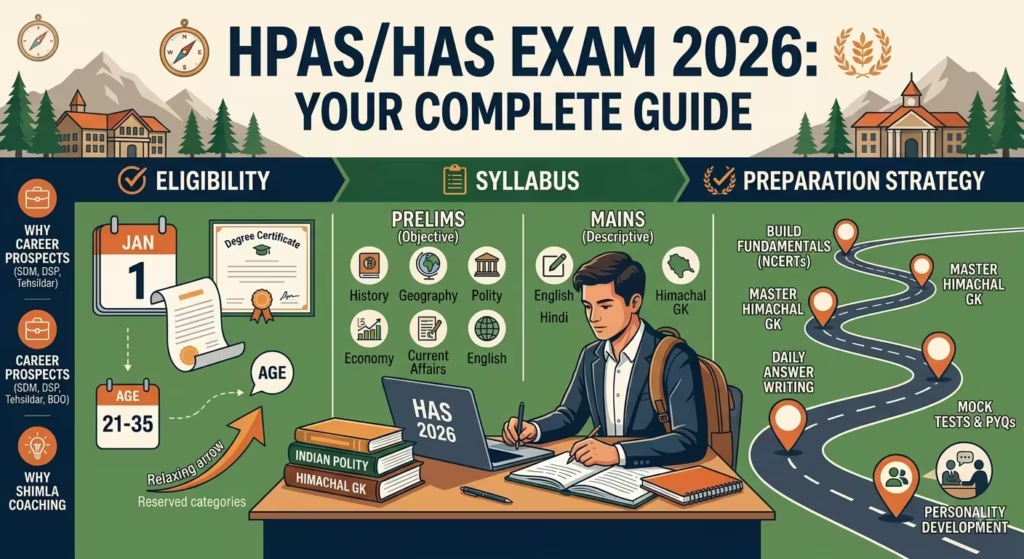
This blog provides a complete guide to the HPAS/HAS Exam 2026 — covering eligibility, syllabus, preparation strategies, career prospects, and why structured coaching in Shimla can make all the difference.
HPAS Exam 2026 – Eligibility Criteria
Before starting preparation, it is very important to check whether you are eligible for the exam. The Himachal Pradesh Public Service Commission (HPPSC) has set certain rules that every candidate must follow. Let’s break them down step by step:
1. Nationality
- You must be a citizen of India.
- This means only Indian nationals can apply for the HPAS/HAS exam.
2. Age Limit
- Minimum Age: You should be at least 21 years old on the date mentioned in the official notification.
- Maximum Age: You should not be more than 35 years old.
- Calculation Date: January 1 of the respective year of examination
- Relaxation: For candidates belonging to SC, ST, and OBC categories, the upper age limit is relaxed by 5 years (making the maximum age 40).
Always check the official notification for the exact relaxation details, because they may change slightly each year.
3. Educational Qualification
- You must have a Bachelor’s degree from a recognized university.
- This degree can be in any stream — Arts, Science, Commerce, Engineering, etc.
- Final‑year students can also apply, but their admission will be provisional until they submit proof of passing the degree before the interview stage.
4. Number of Attempts
- The number of times you can appear for the exam depends on your category:
- General category: Maximum 6 attempts.
- OBC category: Maximum 9 attempts.
- SC/ST category: No fixed limit — you can attempt as many times as you want until you reach the maximum age limit.
Even if you appear for the Prelims and do not qualify, it will still be counted as one attempt.
HPAS/HAS Exam Pattern & Syllabus
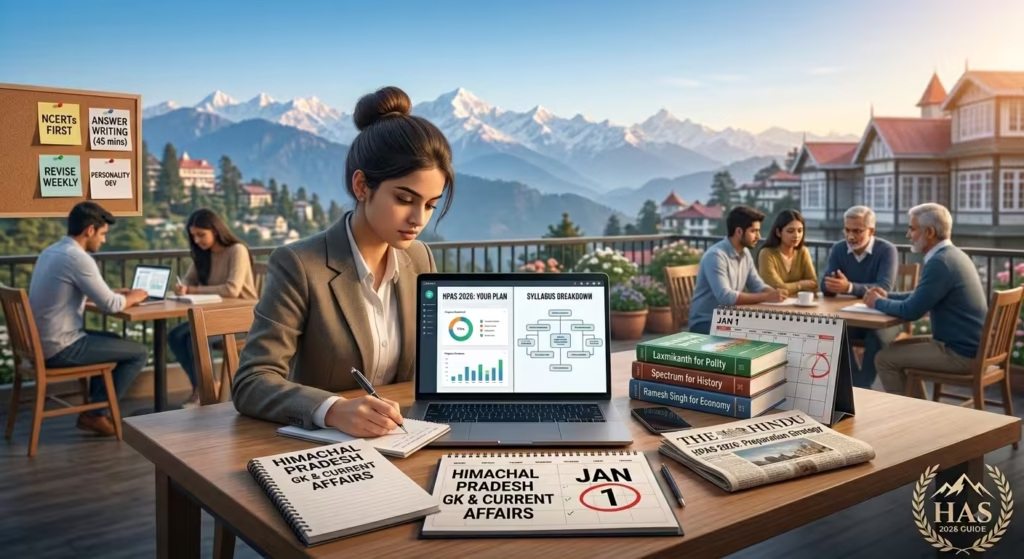
The Himachal Pradesh Administrative Services (HAS/HPAS) exam is conducted in three stages — Preliminary Exam, Mains Exam, and Personality Test (Interview). Each stage is designed to test different skills: knowledge, analytical ability, writing skills, and personality.
1. Preliminary Exam (Objective Type)
The Prelims is the first stage. It is only a qualifying exam; it means its marks are not added to the final merit list. However, you must clear the cut‑off to move to the Mains.
- Paper I: General Studies (200 marks)
- Subjects Covered:
- Indian Polity (Constitution, governance, rights, duties)
- History (Ancient, Medieval, Modern, Himachal Pradesh history)
- Geography (India + Himachal Pradesh)
- Economy (Indian economy, budgets, HP economy)
- Environment & Ecology
- General Science (basic concepts, everyday science)
- Current Affairs (national + Himachal Pradesh specific)
- Purpose: Tests your general awareness and ability to recall facts quickly.
- Subjects Covered:
- Paper II: Aptitude Test (200 marks)
- Subjects Covered:
- Logical reasoning and analytical ability
- Quantitative aptitude (basic mathematics, arithmetic, algebra, geometry)
- Data interpretation (charts, tables, graphs)
- Decision‑making skills
- English comprehension (reading passages, grammar basics)
- Purpose: Tests problem‑solving ability, numerical skills, and comprehension.
- Subjects Covered:
Tip: Since Prelims is qualifying, focus on speed, accuracy, and practice with mock tests. Time management is crucial because you need to attempt many questions in limited time.
2. Mains Exam (Descriptive Type)
The Mains exam is the most important stage because its marks are counted in the final merit list. It requires writing detailed, well‑structured answers in your own words.
- Compulsory Papers:
- English (150 marks): Tests grammar, vocabulary, comprehension, and essay writing in English.
- Hindi (150 marks): Tests grammar, comprehension, and essay writing in Hindi.
- Essay (150 marks): Candidates write essays on topics related to society, politics, economy, environment, and Himachal Pradesh.
- General Studies I (250 marks): History, Geography, and socio‑economic development of Himachal Pradesh.
- General Studies II (250 marks): Indian Polity, Constitution, Governance, International Relations.
- General Studies III (250 marks): Economy, Science & Technology, Environment, Disaster Management, Security issues.
- Optional Papers:
- Candidates choose one optional subject from a list provided by HPPSC.
- Each subject has two papers (300 marks each).
- Examples: Public Administration, Political Science, History, Geography, Sociology, etc.
- Tip: Choose an optional subject you are comfortable with and can score well in.
Tip: Mains is the deciding stage. Success depends on answer writing skills, clarity of thought, and analytical depth. Practice writing daily with proper structure: Introduction → Body → Conclusion.
3. Personality Test (Interview)
The final stage is the Interview, also called the Personality Test.
- Marks: 150
- Focus Areas:
- Confidence and communication skills
- Presence of mind and logical thinking
- Awareness of current affairs and Himachal Pradesh issues
- Suitability for administrative roles (leadership, decision‑making, balance)
Tip: The interview is not only about testing your knowledge. It evaluates whether you have the right personality traits — confidence, balance, and leadership qualities — to serve as an officer. Mock interviews and personality development sessions can help you prepare.
Preparation Strategy for HPAS 2026
Preparing for HPAS/HAS is not just about reading books — it’s about building a smart plan and sticking to it. Think of it as a long journey where every small step counts. Let’s walk through the strategy in detail.
Step 1: Build Strong Fundamentals
This is like laying the foundation of a house. Without strong basics, everything else will feel shaky.
- Start with NCERTs (Class 6–12): These books explain History, Geography, Polity, and Science only. They are easy to understand and help you clear concepts.
- Move to standard books once comfortable:
- Laxmikanth for Polity — covers the Constitution, governance, rights, and duties.
- Spectrum for Modern History — short, crisp, and easy to revise.
- Ramesh Singh for Economy — explains budgets, policies, and economic growth.
- How to study: Read slowly, underline important points, and make short notes. Don’t rush — the goal is understanding, not just finishing.
Step 2: Master Himachal GK
This is where many students lose marks because HPAS gives special importance to Himachal Pradesh.
- What to study: Himachal’s history, geography, culture, economy, and government schemes.
- Sources: HP government reports, economic surveys, and local newspapers like The Tribune Himachal or the Amar Ujala Himachal edition.
- Daily routine: Dedicate at least 30 minutes daily to Himachal GK.
- Note‑making: Create a separate notebook just for Himachal GK. Write down facts like rivers, districts, temples, fairs, festivals, and schemes.
Step 3: Current Affairs Integration
Current affairs are not separate from the syllabus — they are part of it.
- Read newspapers daily: The Hindu or Indian Express are good choices.
- Don’t just memorize headlines: Connect them with your syllabus.
- Example: If a new HP government scheme is launched, link it to Economy and Polity.
- If there’s a natural disaster in Himachal, connect it to Geography and Disaster Management.
- Make notes: Write short points every day. At the end of the week, revise them.
Step 4: Answer Writing Practice
This is the most important part of Mains preparation. Many students know the facts but fail to present them well.
- Daily practice: Spend 45 minutes daily writing answers.
- Structure your answers:
- Introduction: Define or explain the topic briefly.
- Body: Use bullet points, diagrams, or flowcharts to explain.
- Conclusion: End with a balanced view or solution.
- Essay practice: Write one essay every week on topics like governance, environment, or Himachal Pradesh local issues.
Step 5: Mock Tests & PYQs
Practice is what turns preparation into performance.
- Prelims: Attempt weekly mock tests to improve speed and accuracy.
- PYQs (Past Year Question Papers): Solve them to understand the exam trend and question style.
- Mains: Join a test series to get feedback on your writing style.
Step 6: Personality Development
The interview is not about how much you know — it’s about who you are.
- Mock interviews: Practice with mentors or peers to simulate the real experience.
- Communication skills: Speak clearly, avoid jargon, and stay polite.
- Confidence building: Stay updated with current affairs and practice expressing your opinions logically.
- Simple exercise: Read editorials and try to explain them in your own words to a friend. This trains you to think clearly and speak confidently.
Government Jobs Through HPAS
1. SDM (Sub‑Divisional Magistrate)
- Role: Head of a sub‑division, responsible for law and order, revenue collection, disaster management, and scheme implementation.
- Powers: Can issue orders under CrPC, handle land disputes, supervise elections.
- Impact: First point of contact between citizens and administration.
- Estimated Salary: Rs. 56,100 with a grade pay of Rs. 5,400 per month.
2. DSP (Deputy Superintendent of Police)
- Role: Senior police officer maintaining law and order in a subdivision/district.
- Powers: Supervises police stations, leads investigations, ensures crime prevention.
- Impact: Key role in public safety and peacekeeping.
- Estimated Salary: starting at Pay Matrix Level 10 with a basic pay scale of ₹56,100 to ₹1,77,500 per month.
3. Tehsildar
- Role: In charge of a tehsil, managing land records, revenue collection, and property disputes.
- Powers: Oversees mutation of land records, issues certificates, enforces revenue laws.
- Impact: Vital for rural administration, directly interacting with farmers and landowners.
- Estimated Salary: Pay Level 13 (₹46,000 – ₹1,46,500)
4. Block Development Officer (BDO)
- Role: Responsible for development activities in a block (cluster of villages).
- Powers: Supervises Panchayati Raj institutions, implements rural development schemes, monitors welfare programs.
- Impact: Ensures government schemes like housing, employment, and sanitation reach grassroots.
- Estimated Salary: Pay Level 17 (₹53,600 – ₹1,70,100)
Why Shimla is the Right Place for Coaching
Choosing the right city for exam preparation is just as important as choosing the right institute. Shimla, the capital of Himachal Pradesh, has become a hub for competitive exam coaching — especially for HPAS/HAS aspirants. Here’s why:
1. Peaceful Environment for Focused Study
- Shimla’s calm surroundings and cool climate create the perfect atmosphere for concentration.
- Unlike metro cities, there is less noise, pollution, and distraction.
- Students can focus better on their studies without the stress of overcrowded urban life.
- The natural environment also helps reduce exam anxiety and keeps the mind fresh.
2. Localized Focus on Himachal GK
- HPAS/HAS exams give special weightage to Himachal Pradesh General Knowledge.
- Coaching centers in Shimla naturally emphasize this area, as faculty and resources are locally available.
- Students get access to authentic information about Himachal’s history, geography, economy, and culture.
- Local newspapers, government reports, and regional updates are easier to follow when you’re in Shimla.
3. Affordable Coaching Compared to Delhi or Chandigarh
One of the biggest advantages of preparing for HPAS/HAS in Shimla is affordability. Both coaching fees and living expenses are significantly lower compared to metro cities like Delhi and Chandigarh.
Coaching Fees
- Shimla: Most HPAS/HAS coaching institutes charge between ₹15,000–₹30,000 per course. Some even offer short‑term batches starting from ₹999 for foundation classes.
- Chandigarh: Institutes like IBTS charge around ₹72,000 per year for hybrid coaching (offline + online).
- Delhi: Top IAS/HPAS coaching centers charge ₹90,000 per year for offline courses, while online batches may cost around ₹45,000.
This means Shimla coaching is 50–70% cheaper than Delhi or Chandigarh, while still offering specialized focus on Himachal GK.
Living Expenses
- Shimla: Hostel accommodation ranges from ₹4,000–₹6,000 per month, food around ₹3,000–₹4,000, and transport is minimal since institutes are centrally located.
- Chandigarh: Accommodation costs around ₹7,000–₹10,000 per month, plus food and transport add another ₹5,000–₹6,000.
- Delhi: Living costs are highest — hostels or PGs cost ₹10,000–₹15,000 per month, with food and transport adding ₹6,000–₹8,000.
Overall, living in Shimla can save students ₹50,000–₹70,000 per year compared to Delhi or Chandigarh.
Flexible Options
- Many Shimla institutes offer installment payment plans.
- Affordable online courses are available for students outside Shimla.
- Hybrid models (online + offline) allow flexibility without extra cost.
4. Access to Experienced Faculty Familiar with HPPSC Trends
- Shimla has several reputed coaching institutes with faculty who specialize in HPAS/HAS exam trends.
- Teachers often have years of experience guiding students through Prelims, Mains, and Interviews.
- They provide insights into the latest question patterns, answer writing techniques, and interview expectations.
- Local faculty also understand the importance of Himachal GK and integrate it naturally into the curriculum.
Additional Benefits of Studying in Shimla
- Community of Aspirants: You’ll be surrounded by motivated peers preparing for HPAS, SSC, Banking, and other exams. This creates healthy competition and group learning.
- Accessibility: Coaching centers are located in areas like Sanjauli, Dhalli, and Lakkar Bazar, which are easily reachable by public transport.
- Hybrid Options: Many institutes now offer both offline and online classes, giving students flexibility.
Online vs Offline Coaching
Choosing between online, offline, or hybrid coaching depends on your personal study style, budget, and lifestyle. Each mode has its own strengths.
Online Coaching
- Flexibility: Students can attend classes from anywhere — home, hostel, or even while traveling.
- Recorded Lectures: If you miss a class, you can watch the recording later. This is especially useful for revision.
- Mock Tests: Online platforms provide regular test series with instant performance analysis.
- Cost‑Effective: Online courses are usually cheaper than offline ones. For example, Delhi online batches may cost around ₹45,000, while Shimla institutes offer online courses starting from ₹999.
- Challenges: Requires self‑discipline. Without a classroom environment, some students may struggle with consistency.
Best for students who want flexibility, lower costs, and the ability to learn at their own pace.
Offline Coaching
- Classroom Interaction: Direct face‑to‑face learning with teachers. You can ask doubts instantly.
- Peer Learning: Studying with classmates creates healthy competition and motivation.
- Mentorship: Teachers can personally guide students, check their progress, and provide feedback.
- Structured Routine: Fixed class timings help maintain discipline.
- Costs: Higher than online. In Delhi, offline courses can cost ₹90,000 per year, while Shimla institutes charge ₹15,000–₹30,000.
- Challenges: Less flexibility. Students must attend classes at specific times and locations.
Best for students who prefer direct interaction, structured schedules, and personal mentorship.
Hybrid Coaching
- Combination of Online + Offline: Students can attend some classes in person and others online.
- Flexibility + Guidance: Offers the convenience of online learning with the personal touch of offline mentorship.
- Balanced Approach: Ideal for working professionals or college students who cannot attend all classes physically.
- Cost: Mid‑range. Hybrid courses in Chandigarh cost around ₹72,000 per year, while Shimla institutes offer affordable hybrid options at ₹20,000–₹40,000.
Best for students who want flexibility but also value classroom interaction and personal guidance.
Featured Coaching Option in Shimla
Why Choose Gurukulam Coaching Institute for HPAS/HAS Coaching
Preparing for HPAS/HAS requires discipline, guidance, and exam‑oriented strategies. While self‑study builds a foundation, a structured coaching institute can provide the edge needed to succeed. Gurukulam Coaching Institute in Shimla has become a trusted name among aspirants, and here’s why:
The Gurukulam Advantage
1. Expert Faculty
- Gurukulam’s faculty members have years of experience guiding HPAS/HAS aspirants.
- They specialize in subjects like Polity, History, Economy, and Himachal GK.
- Teachers provide exam‑specific insights — for example, how to frame answers in Mains or how to approach tricky Prelims questions.
- Many faculty members have mentored students who successfully cleared HPAS and other competitive exams.
2. Structured Courses
- The institute offers step‑by‑step coverage of all three stages: Prelims, Mains, and Interview.
- Courses are designed to move from basic concepts (NCERTs) to advanced topics (standard books + current affairs).
- Special focus on answer writing practice and essay preparation for Mains.
- Interview guidance includes mock interviews, personality development, and communication training.
3. Regular Test Series
- Weekly Prelims mock tests to improve speed and accuracy.
- Mains test series with detailed feedback on writing style, structure, and content.
- Answer writing sessions where students learn to present information clearly and concisely.
- Performance tracking helps students identify strengths and weaknesses.
4. Affordable Fees
- Gurukulam keeps its courses budget‑friendly, starting at just ₹999 for foundation batches.
- Full HPAS/HAS courses are priced much lower than metro city institutes, making them accessible to students from Himachal and nearby states.
- Flexible payment options and installment plans are available.
- Compared to Delhi (₹90,000/year) and Chandigarh (₹72,000/year), Gurukulam’s fees are 50–70% cheaper. Gurukulam Coaching Institute provides the best online coaching under Rs 12,999 with complete study materials.
5. Flexible Learning Options
- Offline classes at the Shimla campus for students who prefer classroom interaction.
- Online classes with live sessions, recorded lectures, and digital study material for remote learners.
- Hybrid model (online + offline) for maximum flexibility.
- Students can switch between modes depending on their schedule and convenience.
6. Local Focus on Himachal GK
- HPAS/HAS exams give importance to Himachal Pradesh General Knowledge.
- Gurukulam integrates Himachal GK into daily classes, test series, and study material.
- Students will learn about Himachal’s history, geography, economy, culture, and government schemes.
- This localized focus gives Gurukulam students a clear advantage over aspirants studying in Delhi or Chandigarh.
Additional Benefits
- Community of Aspirants: Students preparing for HPAS, SSC, Banking, and Police exams study together, creating a motivating environment.
- Accessible Location: The institute is located at Verma Niwas, Dhalli Bypass, Shimla — easily reachable by public transport.
- Proven Results: Gurukulam has a track record of helping students clear competitive exams with structured guidance.
Courses Offered: Both Online and Offline
- HAS/HPAS Coaching (flagship program).
- HP Police Constable Coaching.
- SSC and Banking Exam Coaching.
📍 Visit us at Verma Niwas, Dhalli Bypass, near Shimla Lights, Chalaunthi, Chalonti, Sanjauli, Shimla, Himachal Pradesh 171006
📞 Call/Whatsapp: 7018142175
🌐 Website: online.gurukulamcoachinginstitute.com
Conclusion
The HPAS/HAS Exam 2026 is not just another competitive test — it’s a gateway to a prestigious administrative career in Himachal Pradesh. Clearing this exam means joining the ranks of officers who shape policies, manage development, and serve the people directly.
To succeed, aspirants must combine smart preparation, structured study plans, and consistent practice. Building a strong foundation through NCERTs, mastering Himachal GK, and practicing answer writing regularly are essential steps.
While self‑study helps develop discipline, coaching institutes like Gurukulam Coaching Institute, Shimla, provide the strategic guidance, mentorship, and exam‑oriented approach that make the difference. With expert faculty, affordable fees, and flexible online/offline classes, Gurukulam ensures that every student receives personalized attention and practical insights into HPPSC trends.
For anyone serious about cracking HPAS/HAS 2026, the journey begins today — with clarity, consistency, and the right support system. Start early, stay focused, and let your preparation turn into success.
Frequently Asked Questions (FAQs)
1. What are the eligibility criteria for the HPAS/HAS Exam 2026?
Candidates must be Indian citizens, aged between 21–35 years (with relaxations for reserved categories), and hold a bachelor’s degree from a recognized university.
2. How many attempts are allowed in the HPAS exam?
General category candidates can attempt 6 times, OBC candidates 9 times, and SC/ST candidates have unlimited attempts until the age limit.
3. What is the exam pattern of HPAS/HAS?
The exam has three stages: Prelims (objective), Mains (descriptive), and Interview (personality test).
4. Which subjects are included in the HPAS syllabus?
Subjects include Polity, History, Geography, Economy, Environment, Science, Current Affairs, Aptitude, and Himachal Pradesh GK.
5. How important is Himachal GK in the HPAS exam?
Very important. Himachal GK is heavily tested in both Prelims and Mains, and often asked in interviews.
6. When will the HPAS/HAS Exam 2026 notification be released?
The official notification is usually released by HPPSC in the first half of the year. Candidates should regularly check the HPPSC website for updates.
7. Is coaching necessary for HPAS preparation?
While self‑study is possible, coaching provides structured guidance, test series, and mentorship — useful for answer writing and interview preparation.
8. Why is Shimla considered the best place for HPAS coaching?
Shimla offers a peaceful environment, affordable fees (₹15,000–₹30,000), localized focus on Himachal GK, and experienced faculty familiar with HPPSC trends.
9. What is the difference between online and offline coaching for HPAS?
Online coaching is flexible and cheaper; offline coaching offers classroom interaction and mentorship, while hybrid coaching combines both advantages.
10. Best HAS Coaching in Shimla?
Gurukulam Coaching Institute is the best HAS coaching in Shimla because it provides the best online coaching under Rs 12999 with complete study materials.