
The Himachal Pradesh Administrative Services (HPAS/HAS) Exam is one of the most prestigious state-level examinations, offering aspirants the chance to serve in public administration as officers like SDM, DSP, Tehsildar, and BDO. It’s not just a test of knowledge but also of discipline, analytical ability, and personality.
Cracking this exam isn’t only about hard work — it requires a structured plan, consistent practice, and smart strategies. Below is a detailed step‑by‑step preparation roadmap to help aspirants prepare effectively for both Prelims and Mains. Here’s a step‑by‑step guide to help aspirants prepare for HPAS exam 2026.
Step 1: Understand the Exam Structure and Prepare for HPAS Exam
The HPAS exam is conducted in three stages, and each stage plays a unique role in selecting the right candidates for administrative services.
1. Preliminary Exam (Screening Test)
The Prelims is the first stage of the HPAS exam. Its main purpose is to filter candidates for the Mains exam. Although marks from Prelims are not counted in the final merit list, this stage is crucial because only those who clear it can move forward.
Format of Prelims
The exam consists of two objective papers (Multiple Choice Questions):
- Paper I: General Studies (200 marks)
- Subjects Covered:
- History (Ancient, Medieval, Modern, and Himachal’s history)
- Geography (Physical, Indian, and Himachal Geography)
- Polity (Indian Constitution, governance, rights, duties)
- Economy (basic concepts, Indian economy, Himachal’s economy)
- Environment & Ecology (climate change, biodiversity, HP environment issues)
- Science (basic Physics, Chemistry, Biology, everyday science)
- Current Affairs (national, international, and Himachal‑specific events)
- Purpose: Tests your general awareness, factual knowledge, and ability to recall quickly.
- Subjects Covered:
- Paper II: Aptitude Test (200 marks)
- Subjects Covered:
- Logical reasoning and analytical ability
- Quantitative aptitude (basic mathematics, percentages, ratios, averages, probability)
- Data interpretation (charts, graphs, tables)
- Decision‑making and problem‑solving
- English comprehension and communication skills
- Purpose: Tests your mental ability and problem‑solving skills.
- Qualifying Nature: You must score at least 33% marks in this paper. Marks are not added to merit.
- Subjects Covered:
Key Points to Remember
- Qualifying Stage Only: Prelims is just a screening test. Marks here do not count in the final merit list.
- Negative Marking: For every wrong answer, 1/3rd of the marks assigned to that question are deducted.
- Cut‑off: You must clear the cut‑off marks in Paper I (General Studies) to qualify for Mains.
- Accuracy Matters: Guesswork can hurt because of negative marking.
- Time Management: Each paper is 2 hours long, so practice solving MCQs within time limits.
Why Prelims is Important
- It decides whether you move to the Mains stage.
- Builds your exam temperament and helps you understand the question pattern.
- Prelims preparation also strengthens your Mains foundation, since subjects overlap.
2. Mains Exam (Written Test)
The Mains exam is the most crucial stage of HPAS because the marks obtained here are counted in the final merit list. Unlike Prelims, which is objective, Mains is descriptive and tests your ability to express ideas clearly, analyse issues deeply, and present structured arguments.
Purpose
- To evaluate your knowledge, analytical ability, and writing skills.
- To check whether you can think critically, organise thoughts logically, and communicate effectively — qualities essential for an administrator.
Format of Mains
The exam consists of compulsory papers and optional papers:
Compulsory Papers
- English (150 marks)
- Tests grammar, vocabulary, comprehension, and essay writing.
- Focus on clarity, precision, and effective expression.
- Hindi (150 marks)
- Tests grammar, comprehension, and essay writing in Hindi.
- Important for candidates to show proficiency in the state language.
- Essay (150 marks)
- Topics usually relate to society, politics, economy, environment, and Himachal Pradesh.
- Requires balanced arguments, examples, and structured writing.
- General Studies I (250 marks)
- History (India + Himachal Pradesh)
- Geography (India + Himachal Pradesh)
- Socio‑economic development of Himachal Pradesh
- General Studies II (250 marks)
- Indian Polity and Constitution
- Governance and Public Administration
- International Relations
- General Studies III (250 marks)
- Economy (India + Himachal Pradesh)
- Science & Technology
- Environment & Ecology
- Disaster Management
- Security issues
Optional Papers
- Candidates choose one optional subject from a list provided by HPPSC.
- Each subject has two papers (300 marks each).
- Popular choices include:
- Public Administration
- Political Science
- History
- Geography
- Sociology
- English Literature
- Economics
- The optional subject allows candidates to specialise in one area and score high with focused preparation.
Key Points to Remember
- Marks Count: Unlike Prelims, Mains marks are added to the final merit list.
- Answer Writing: Success depends on your ability to write structured, analytical, and well‑explained answers.
- Depth of Knowledge: You must go beyond facts — show analysis, examples, and clarity of thought.
- Presentation: Use headings, bullet points, diagrams, and flowcharts to make answers easy to read.
- Time Management: Each paper is 3 hours long; practice writing within time limits.
- Language Skills: Good English/Hindi expression is rewarded with higher marks.
Why Mains is Important
- It is the deciding stage of the exam.
- Tests not just knowledge but also your ability to think like an administrator.
- Strong performance in Mains can compensate for average Prelims scores.
- Builds the foundation for the Interview stage, where clarity and confidence are equally important.
3. Personality Test (Interview)
The Personality Test is the final stage of the HPAS exam and carries 150 marks. Unlike Prelims and Mains, which test knowledge, the interview evaluates whether you have the qualities of a capable administrator. It is designed to assess your mental calibre, social awareness, and leadership potential.
Purpose
- To judge your suitability for administrative roles.
- To evaluate not just what you know, but how you think, how you communicate, and how you carry yourself.
- To ensure you have the right mix of confidence, balance, and integrity to serve the public.
Format
- Conducted as a face‑to‑face interview by a panel of experts from the Himachal Pradesh Public Service Commission (HPPSC).
- The panel has access to your academic record, background, and Mains performance.
- Duration: Usually 20–30 minutes, but can vary depending on the discussion.
Focus Areas
- Confidence and Communication Skills
- Speak clearly and confidently.
- Maintain eye contact and positive body language.
- Avoid memorised answers — respond naturally and logically.
- Awareness of Current Affairs and Himachal Issues
- Be updated on national and international events.
- Know about Himachal Pradesh’s culture, economy, schemes, and challenges.
- Example topics: tourism, hydropower, agriculture, disaster management.
- Logical Thinking and Presence of Mind
- Be prepared for situational questions like:
- “How would you handle a flood in your district?”
- “What steps would you take to improve education in rural Himachal?”
- Show practical, balanced solutions.
- Be prepared for situational questions like:
- Leadership Qualities, Balance, and Integrity
- Demonstrate that you can lead teams, make fair decisions, and uphold ethics.
- Show empathy towards people’s problems while being firm and rational.
Key Points to Remember
- Marks Count: Interview marks are added to Mains scores to prepare the final merit list.
- Not Just Knowledge: The panel looks for personality traits, confidence, and administrative aptitude.
- Honesty Matters: If you don’t know an answer, admit it politely instead of guessing.
- Tie‑Breaking Role: In case of equal scores, interview marks often decide the final ranking.
Preparation Tips
- Read newspapers daily and revise Himachal GK.
- Practice mock interviews with mentors or peers.
- Work on body language — sit upright, smile naturally, and avoid nervous gestures.
- Be ready for personal questions like:
- “Why do you want to join HPAS?”
- “Tell us about your strengths and weaknesses.”
- “What contribution can you make to Himachal Pradesh?”
Important Note
- Prelims marks are not counted in the final merit, but they decide whether you qualify for Mains.
- The final merit list is prepared based on Mains + Interview marks.

Step 2: Build Strong Fundamentals for HPAS Exam
Before diving into advanced books and coaching materials, it’s important to create a solid foundation of knowledge. This step ensures that you understand concepts clearly and can apply them in both Prelims (objective questions) and Mains (descriptive answers).
Start with NCERTs (Class 6–12)
- Why NCERTs?
- They explain concepts in simple language.
- Provide authentic and reliable information.
- Cover the basics of History, Geography, Polity, and Science, which are directly asked in Prelims.
- How to Read Them:
- Read systematically, starting from Class 6 and moving upward.
- Highlight important facts, definitions, and examples.
- Make chapter‑wise notes for quick revision.
Subjects to Focus On
- History: Ancient, Medieval, and Modern (Class 6–12 NCERTs).
- Geography: Physical, Human, and Indian Geography.
- Polity: Basics of the Constitution, rights, duties, and governance.
- Science: General concepts in Physics, Chemistry, Biology, and Environmental Science.
These subjects form the core of General Studies Paper I in Prelims and also help in Mains essays and GS papers.
Make Short Notes While Reading
- Write down key points in your own words.
- Use bullet points, flowcharts, and diagrams for clarity.
- Keep notes concise so they can be revised quickly before exams.
- Example: For Geography, make a chart of major rivers, mountains, and climatic zones of India.
Benefits of Strong Fundamentals
- Helps you understand advanced reference books more easily.
- Builds confidence for tackling MCQs in Prelims.
- Provides a base for writing structured answers in Mains.
- Ensures you don’t miss out on basic but frequently asked questions.
In short: NCERTs are your foundation. Without them, advanced books may feel overwhelming. With them, you’ll have clarity, confidence, and a strong base to build upon.
Step 3: Refer to Standard Books
Once the basics are clear, move to trusted reference books:
- Polity: M. Laxmikanth
- Modern History: Spectrum
- Economy: Ramesh Singh
- Geography: NCERT + GC Leong
- Environment: Shankar IAS
Keep sources limited and revise them multiple times instead of collecting too many books.
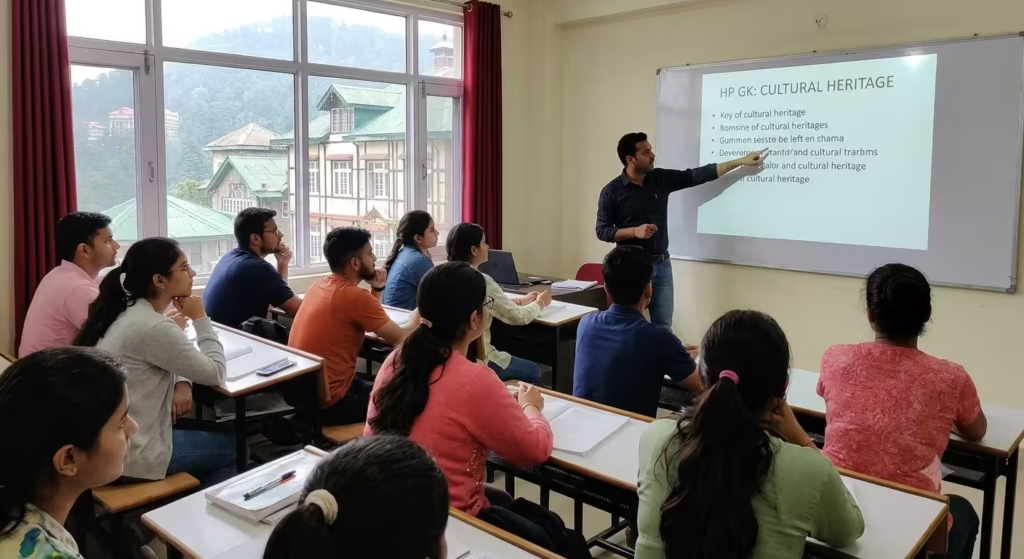
Step 4: Focus on Himachal GK
One of the unique features of the HPAS exam is its strong emphasis on Himachal Pradesh General Knowledge (HP GK). Unlike national exams, HPAS requires aspirants to have in‑depth awareness of the state’s history, geography, culture, and economy, because administrators are expected to serve the people of Himachal Pradesh directly.
Why Himachal GK is Important
- A significant portion of Prelims and Mains questions are based on Himachal GK.
- It helps in the Essay paper and Interview stage, where local issues are often discussed.
- Knowledge of HP’s culture, economy, and governance makes you stand out as a candidate who understands the state deeply.
Sources to Study Himachal GK
- Local Newspapers
- The Tribune Himachal, Amar Ujala HP edition, Dainik Jagran HP edition.
- Focus on state government schemes, policies, and local events.
- HP Government Reports
- Economic Survey of Himachal Pradesh
- Budget documents
- Annual reports of departments (Agriculture, Tourism, Education, etc.)
- Books & Guides
- Himachal Pradesh General Knowledge by Dr Rakesh Kumar.
- HPPSC official publications and past year papers.
- Online Resources
- HPPSC website for syllabus and notifications.
- Himachal government portals for schemes and policies.
What to Cover in Himachal GK
- History: Ancient kingdoms, freedom struggle in HP, formation of Himachal Pradesh.
- Geography: Rivers, mountains, climate zones, forests, wildlife sanctuaries.
- Culture: Temples, fairs, festivals, traditional food, folk dances.
- Economy: Agriculture, horticulture, tourism, hydropower, industries.
- Administration: Districts, Panchayati Raj system, welfare schemes.
How to Study Himachal GK Effectively
- Maintain a separate notebook for HP GK.
- Divide it into sections: History, Geography, Culture, Economy, Schemes.
- Use charts, maps, and tables for easy recall.
- Dedicate at least 30 minutes daily to Himachal GK.
- Revise weekly to keep facts fresh in memory.
In short: Himachal GK is the backbone of HPAS preparation. It not only helps in Prelims and Mains but also gives you confidence in the Interview when asked about local issues.
Step 5: Practice Answer Writing
Answer writing is the heart of the Mains exam. Even if you know the facts, success depends on how well you can present them in a clear, structured, and analytical way. Practising regularly helps you develop speed, clarity, and confidence.
1. Set a Daily Writing Routine
Dedicate a fixed time daily to writing answers.
- Spend 45 minutes daily on answer writing.
- Choose 2–3 questions from GS or optional subjects.
- Write within the word limit (150–250 words)
2. Structure Your Answers
Organise answers into clear sections for readability.
- Introduction: Define or explain briefly
- Body: Use bullet points, diagrams, or flowcharts
- Conclusion: Provide a balanced view or solution
3. Use Diagrams & Flowcharts
Visuals make answers more engaging and easy to understand.
- Add maps for Geography questions.
- Use flowcharts for processes (e.g., governance reforms)
- Keep diagrams simple and neat.
4. Practice Essay Writing Weekly
Develop analytical depth and writing style for essays.
- Write one essay every week on topics like governance, environment, and Himachal issues.
- Focus on clarity, logical flow, and balanced arguments.
- Use examples from current affairs and HP context.
5. Review & Improve
Analyse your writing to identify strengths and weaknesses.
- Compare with model answers or toppers’ copies.
- Check for grammar, clarity, and relevance.
- Rewrite weak answers to improve presentation.
Extra Tips
- Stick to the word limit — writing too much wastes time.
- Use simple language; avoid jargon unless necessary.
- Always connect answers to Himachal context wherever possible.
- Practice writing under timed conditions to simulate exam pressure.
Step 6: Attempt Mock Tests
- Take weekly mock tests to improve speed and accuracy.
- Solve previous year papers (PYQs) to understand exam trends.
- Treat mock tests as rehearsals before the final exam.
Step 7: Revise Current Affairs
Current affairs play a crucial role in both Prelims and Mains. They test how well you connect daily events with concepts in polity, economy, environment, and Himachal Pradesh issues. A strong grip on current affairs also boosts your essay writing and interview performance.
Daily Reading
- Read The Hindu or Indian Express every day.
- Focus on:
- National news (polity, economy, environment, science & tech).
- International relations (India’s role in global events).
- Himachal Pradesh news (government schemes, local issues, development projects).
- Avoid spending too much time on entertainment or irrelevant news.
Link National Events to Himachal Context
This is where HPAS differs from UPSC — you must connect national issues to Himachal Pradesh.
- Example 1: A new HP government scheme → link it to Economy & Polity.
- Example 2: A natural disaster in HP → connect it to Geography & Disaster Management.
- Example 3: A national education policy → analyse its impact on schools in Himachal Pradesh.
This approach shows examiners that you can apply knowledge locally, which is essential for an administrator.
Monthly Revision
- At the end of each month, revise all important events.
- Prepare short notes in bullet points for quick recall.
- Organise notes under headings:
- Polity & Governance
- Economy & Budget
- Environment & Disaster Management
- Science & Technology
- Himachal GK (schemes, fairs, festivals, reports)
Use Magazines & Reports
- Yojana & Kurukshetra → socio‑economic issues.
- Economic Survey of India & Himachal Pradesh → economy and development.
- India Year Book → government schemes and policies.
Benefits of Regular Revision
- Helps in Prelims MCQs where factual recall is needed.
- Strengthens Mains answers with updated examples.
- Improves Essay writing by adding current references.
- Builds confidence for the Interview, where questions are often based on recent events.
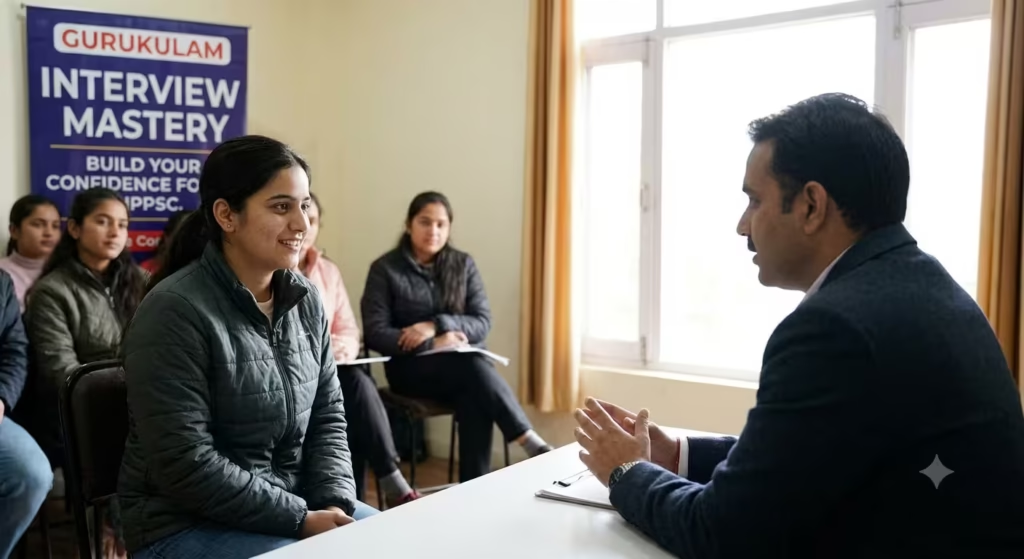
Step 8: Prepare for the Personality Test
The Personality Test (Interview) is the final stage of the HPAS exam. Unlike Prelims and Mains, which test knowledge, the interview evaluates whether you have the qualities of a future administrator. It is about your confidence, communication, awareness, and suitability for public service.
Stay Updated on Current Affairs & Himachal Culture
- Read newspapers daily (The Hindu, Indian Express, The Tribune Himachal).
- Focus on state issues: government schemes, local development projects, environmental challenges, and cultural events.
- Be aware of national and international events and think about how they affect Himachal Pradesh.
- Learn about Himachal’s customs, dialects, fairs, and festivals — these often come up in interviews.
Work on Communication Skills
- Practice speaking answers clearly and confidently.
- Avoid memorised responses — instead, explain logically and naturally.
- Use simple language; don’t try to impress with jargon.
- Record yourself answering questions to check tone, clarity, and body language.
Build Confidence & Logical Thinking
- Confidence comes from knowledge + practice.
- When asked a tricky question, pause, think, and then answer calmly.
- If you don’t know something, admit it politely instead of guessing.
- Develop the habit of analysing issues from multiple angles (social, economic, political, environmental).
Practice Mock Interviews
- Sit with mentors, teachers, or peers and simulate interview conditions.
- Ask them to give feedback on:
- Body language (eye contact, posture, gestures).
- Tone of voice (polite, firm, confident).
- Content (clarity, depth, relevance).
- Practice answering questions like:
- “Why do you want to join HPAS?”
- “What challenges does Himachal Pradesh face today?”
- “How would you handle a natural disaster in your district?”
Key Qualities Interviewers Look For
- Mental alertness – quick thinking and presence of mind.
- Balanced judgment – ability to weigh pros and cons before deciding.
- Leadership skills – ability to work with people and inspire trust.
- Integrity – honesty and moral strength.
- Social awareness – sensitivity to local issues and people’s needs.
Final Tips
- Dress formally and neatly.
- Be polite and respectful throughout.
- Keep answers short, structured, and logical.
- Show enthusiasm for serving Himachal Pradesh.
Conclusion
The HPAS Exam 2026 is not just another competitive test — it is a gateway to a prestigious career in public administration. Clearing this exam means becoming part of the administrative machinery that shapes policies, manages development, and serves the people of Himachal Pradesh directly.
For aspirants, this exam is a golden opportunity to prove their dedication, discipline, and ability to take on leadership roles. Success in HPAS requires:
- A structured preparation plan that covers Prelims, Mains, and Interview stages.
- Consistent practice through answer writing, mock tests, and revision.
- A strong focus on Himachal GK, since knowledge of the state’s history, geography, culture, and economy is vital.
Shimla, with its peaceful environment and strong academic culture, provides the perfect setting for focused preparation. Surrounded by natural beauty and a supportive learning atmosphere, aspirants can study with clarity and determination.
With the right mix of hard work, smart strategies, and proper guidance, cracking HPAS 2026 is absolutely achievable. For serious candidates, this exam is the pathway to becoming an administrator who serves society and contributes to the progress of Himachal Pradesh.
Begin your HPAS journey today with Gurukulam Coaching Institute, Shimla. Get expert guidance, structured preparation, and personalised mentorship. Enrol now and move closer to success in HPAS 2026.
Visit us at Verma Niwas, Dhalli Bypass, near Shimla Lights, Chalaunthi, Chalonti, Sanjauli, Shimla, Himachal Pradesh 171006
Call/Whatsapp: 7018142175
FAQs
1. What is the HPAS/HAS Exam?
The Himachal Pradesh Administrative Services (HPAS/HAS) Exam is a state‑level competitive exam conducted by HPPSC to recruit officers for administrative posts like SDM, DSP, Tehsildar, and BDO.
2. Who conducts the HPAS Exam?
The Himachal Pradesh Public Service Commission (HPPSC) is responsible for conducting the exam.
3. What are the stages of the HPAS Exam?
The exam has three stages: Prelims (objective), Mains (descriptive), and Personality Test (interview).
4. Are Prelims marks counted in the final merit?
No. Prelims is only a qualifying stage. The final merit list is based on Mains + Interview marks.
5. What subjects are covered in the Prelims exam?
Prelims includes General Studies (History, Geography, Polity, Economy, Environment, Science, Current Affairs) and an Aptitude Test (reasoning, quantitative aptitude, decision‑making, English comprehension).
6. How important is Himachal GK in HPAS preparation?
Very important. A significant portion of the exam focuses on Himachal Pradesh’s history, geography, culture, economy, and government schemes.
7. What is the best way to prepare for Mains answer writing?
Practice daily for 45 minutes, structure answers with introduction‑body‑conclusion, and use diagrams or flowcharts for clarity.
8. Which newspapers should aspirants read for current affairs?
The Hindu, Indian Express, and local Himachal editions of The Tribune or Amar Ujala are recommended.
9. How should aspirants prepare for the Personality Test?
Stay updated on current affairs, improve communication skills, practice mock interviews, and be confident while answering questions.
10. What are the eligibility criteria for HPAS?
Candidates must hold a bachelor’s degree from a recognised university and meet the age criteria (usually 21–35 years, with relaxations for reserved categories).